


Download Fortinet NSE7_OTS-7.2 Mock Test Study Material
NSE7_OTS-7.2 Questions Prepare with Learning Information
Fortinet NSE7_OTS-7.2 Exam consists of 60 multiple-choice questions that must be answered within 120 minutes. The passing score for the exam is 70%. Candidates who pass the exam will receive a Fortinet NSE 7 - OT Security 7.2 certification, which is recognized globally as a testament to their expertise in securing OT environments. Fortinet NSE 7 - OT Security 7.2 certification is valid for two years, after which candidates must retake the exam to maintain certification.
Fortinet NSE7_OTS-7.2 certification exam is a vendor-specific exam that is developed and maintained by Fortinet, a leading provider of cybersecurity solutions. NSE7_OTS-7.2 exam is designed to test the knowledge and skills of IT professionals in areas such as network security, secure architecture, risk management, and compliance. NSE7_OTS-7.2 exam consists of 60 multiple-choice questions, and candidates have 120 minutes to complete it.
NEW QUESTION # 41
An OT network architect must deploy a solution to protect fuel pumps in an industrial remote network. All the fuel pumps must be closely monitored from the corporate network for any temperature fluctuations.
How can the OT network architect achieve this goal?
- A. Configure a fuel server on the corporate network, and deploy a FortiSIEM with a single pattern temperature performance rule on the remote network.
- B. Configure a fuel server on the remote network and deploy a FortiSIEM with a single pattern temperature performance rule on the corporate network.
- C. Configure a fuel server on the remote network, and deploy a FortiSIEM with a single pattern temperature security rule on the corporate network.
- D. Configure both fuel server and FortiSIEM with a single-pattern temperature performance rule on the corporate network.
Answer: B
Explanation:
A fuel server placed in the remote OT network gathers the pump temperature data locally, and FortiSIEM at the corporate side analyzes it with a single-pattern performance rule to detect temperature fluctuations. This gives central visibility without exposing the pumps directly and uses the correct rule type for monitoring operational metrics (temperature).
NEW QUESTION # 42
Refer to the exhibit. You are creating a new operational technology (OT) rule to monitor Modbus protocol traffic on FortiSIEM.
Which action must you take to ensure that all Modbus messages on the network match the rule?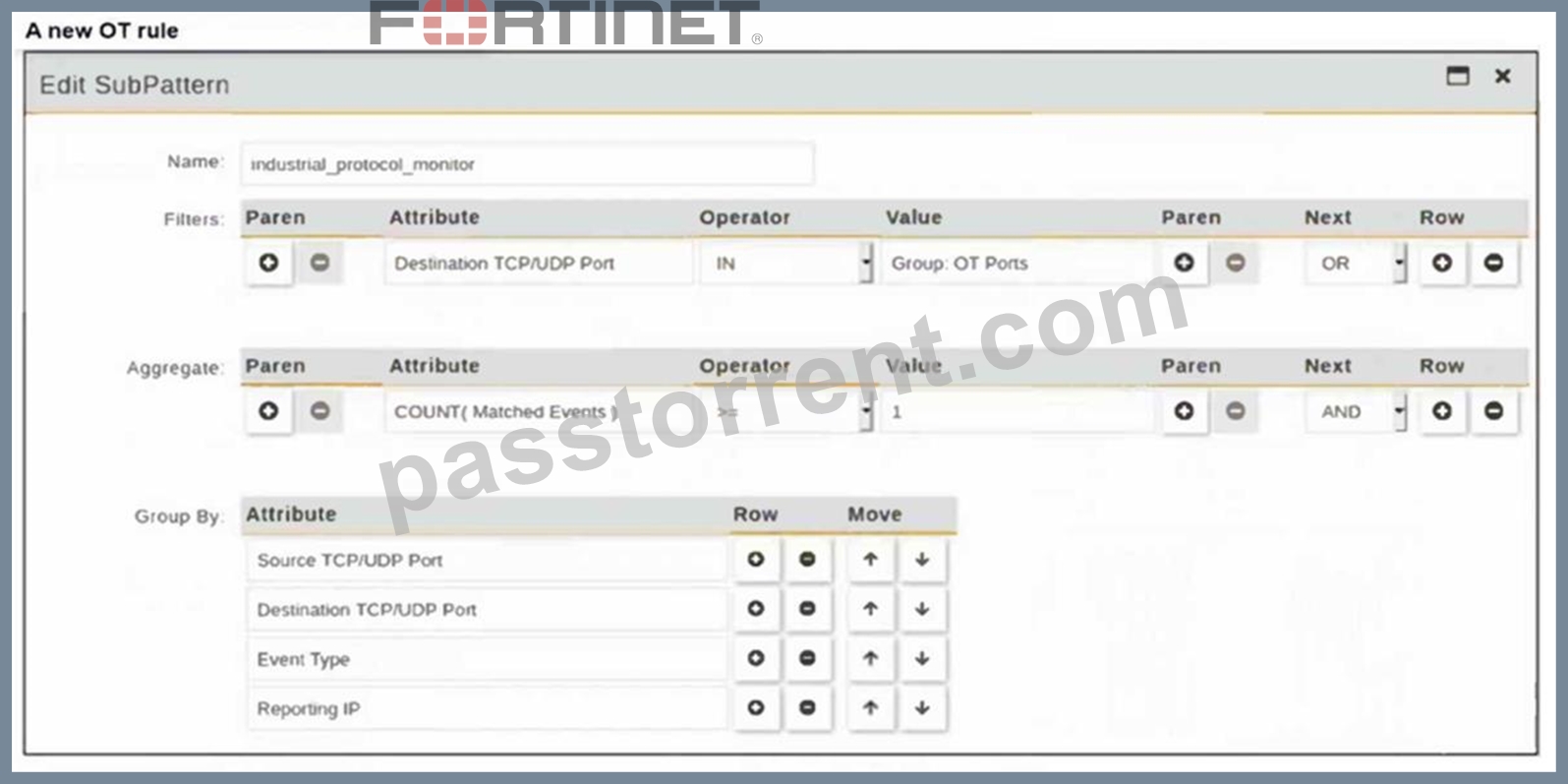
- A. In the Group By section, remove all attributes that are not configured in the Filter section.
- B. In the Aggregate section, set the attribute value to equal to or greater than 0.
- C. Add a new condition to filter Modbus traffic based on the source TCP/UDP port.
- D. The condition on the SubPattern filter must use the AND logical operator.
Answer: B
Explanation:
The current Aggregate condition is set to COUNT(Matched Events) >= 1, which only triggers the rule after at least one event. To ensure all Modbus messages (including the first one) match the rule, the condition must be >= 0, so every event is considered, including the very first occurrence.
NEW QUESTION # 43
An OT architect has deployed a Layer 2 switch in the OT network at Level 1 the Purdue model- process control. The purpose of the Layer 2 switch is to segment traffic between PLC1 and PLC2 with two VLANs. All the traffic between PLC1 and PLC2 must first flow through the Layer 2 switch and then through the FortiGate device in the Level 2 supervisory control network. What statement about the traffic between PLC1 and PLC2 is true?
- A. PLC1 and PLC2 traffic must flow through the Layer-2 switch trunk link to the FortiGate device.
- B. The Layer 2 switches routes any traffic to the FortiGate device through an Ethernet link.
- C. The Layer 2 switch rewrites VLAN tags before sending traffic to the FortiGate device.
- D. In order to communicate, PLC1 must be in the same VLAN as PLC2.
Answer: A
Explanation:
The statement that is true about the traffic between PLC1 and PLC2 is that PLC1 and PLC2 traffic must flow through the Layer-2 switch trunk link to the FortiGate device.
NEW QUESTION # 44
Refer to the exhibit, which shows a non-protected OT environment.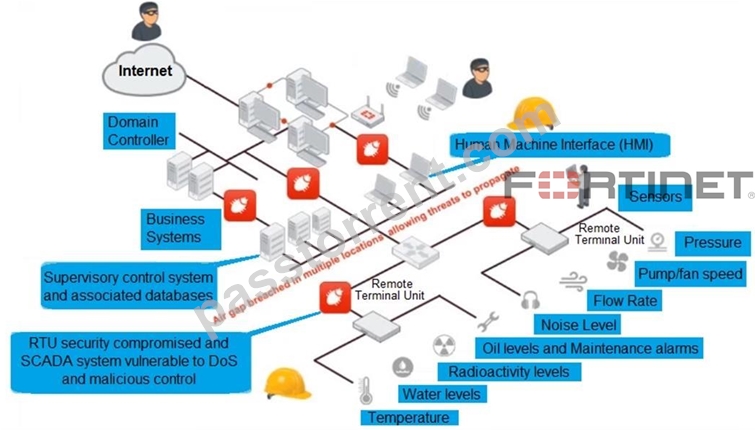
An administrator needs to implement proper protection on the OT network. Which three steps should an administrator take to protect the OT network? (Choose three.)
- A. Use segmentation
- B. Deploy a FortiGate device within each ICS network.
- C. Configure firewall policies with web filter to protect the different ICS networks.
- D. Configure firewall policies with industrial protocol sensors
- E. Deploy an edge FortiGate between the internet and an OT network as a one-arm sniffer.
Answer: C,D,E
NEW QUESTION # 45
Refer to the exhibit. You are assigned to implement a remote authentication server in the OT network. Which part of the hierarchy should the authentication server be part of?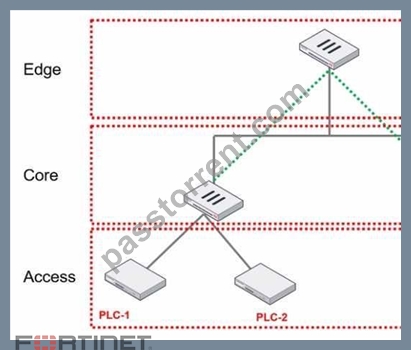
- A. Cloud
- B. Access
- C. Core
- D. Edge
Answer: D
NEW QUESTION # 46
Refer to the exhibit. An OT network security audit concluded that the application sensor requires changes to ensure the correct security action is committed against the overrides filters.
Which change must the OT network administrator make?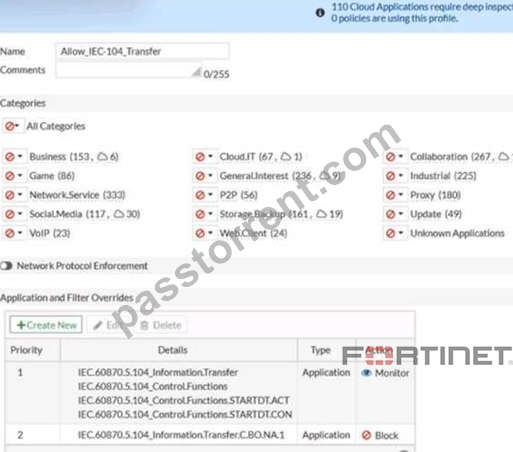
- A. Set all application categories to apply default actions.
- B. Remove IEC.60870.5.104 Information.Transfer from the first filter override.
- C. Change the security action of the industrial category to monitor.
- D. Set the priority of the C.BO.NA.1 signature override to 1.
Answer: D
Explanation:
The application sensor settings allow you to configure the security action for each application category and network protocol override. The security action determines how the FortiGate unit handles traffic that matches the application category or network protocol override. The security action can be one of the following:
Allow: The FortiGate unit allows the traffic without any further inspection. Monitor: The FortiGate unit allows the traffic and logs it for monitoring purposes.
Block: The FortiGate unit blocks the traffic and logs it as an attack. The priority of the network protocol override determines the order in which the FortiGate unit applies the security action to the traffic. The lower the priority number, the higher the priority. For example, a priority of 1 is higher than a priority of 10. In the exhibit, the application sensor has the following settings:
The industrial category has a security action of allow, which means that the FortiGate unit will not inspect or log any traffic that belongs to this category. The IEC.60870.5.104 Information.Transfer network protocol override has a security action of block, which means that the FortiGate unit will block and log any traffic that matches this protocol. The IEC.60870.5.104 Control.Functions network protocol override has a security action of monitor, which means that the FortiGate unit will allow and log any traffic that matches this protocol. The IEC.60870.5.104 Start/Stop network protocol override has a security action of allow, which means that the FortiGate unit will not inspect or log any traffic that matches this protocol. The IEC.60870.5.104 Transfer.C.BO.NA.1 network protocol override has a security action of block, which means that the FortiGate unit will block and log any traffic that matches this protocol. The problem with these settings is that the IEC.60870.5.104 Transfer.C.BO.NA.1 network protocol override has a lower priority than the IEC.60870.5.104 Information.Transfer network protocol override. This means that if the traffic matches both protocols, the FortiGate unit will apply the security action of the higher priority override, which is block. However, the IEC.60870.5.104 Transfer.C.BO.NA.1 protocol is used to transfer binary outputs, which are essential for controlling OT devices. Therefore, blocking this protocol could have negative consequences for the OT network. To fix this issue, the OT network administrator must set the priority of the IEC.60870.5.104 Transfer.C.BO.NA.1 network protocol override to 1, which is higher than the priority of the IEC.60870.5.104 Information.Transfer network protocol override. This way, the FortiGate unit will apply the security action of the lower priority override, which is allow, to the traffic that matches both protocols. This will ensure that the FortiGate unit does not block the traffic that is used to transfer binary outputs, while still blocking the traffic that is used to transfer information.
NEW QUESTION # 47
The OT network analyst runs different level of reports to quickly explore threats that exploit the network.
Such reports can be run on all routers, switches, and firewalls. Which FortiSIEM reporting method helps to identify these type of exploits of image firmware files?
- A. OT/loT reports
- B. Compliance reports
- C. CMDB reports
- D. Threat hunting reports
Answer: D
NEW QUESTION # 48
Refer to the exhibits.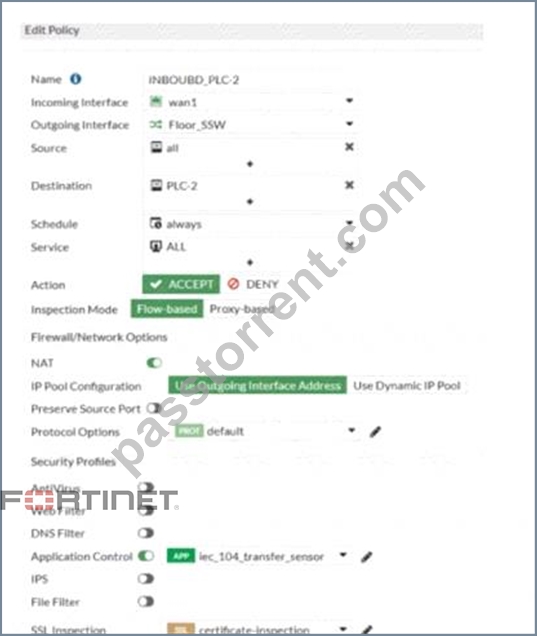
Which statement is true about the traffic passing through to PLC-2?
- A. IPS must be enabled to inspect application signatures.
- B. The application filter overrides the default action of some IEC 104 signatures.
- C. IEC 104 signatures are all allowed except the C.BO.NA 1 signature.
- D. SSL Inspection must be set to deep-inspection to correctly apply application control.
Answer: B
NEW QUESTION # 49
What are two critical tasks the OT network auditors must perform during OT network risk assessment and management? (Choose two.)
- A. Creating disaster recovery plans to switch operations to a backup plant
- B. Planning a threat hunting strategy
- C. Implementing strategies to automatically bring PLCs offline
- D. Evaluating what can go wrong before it happens
Answer: B,D
Explanation:
Planning a threat hunting strategy is essential for proactively searching for threats and vulnerabilities in the OT environment before they manifest into attacks.
Evaluating what can go wrong before it happens is a core part of risk assessment, involving the identification and analysis of potential risks and their impacts on OT systems.
Implementing strategies to automatically bring PLCs offline is generally not a responsible or safe approach in OT environments because it could disrupt critical industrial processes.
Creating disaster recovery plans is important for overall business continuity but is not primarily a task of auditors during risk assessment-it is more of a broader business continuity or incident response responsibility.
NEW QUESTION # 50
When you create a user or host profile, which three criteria can you use? (Choose three.)
- A. Host or user group memberships
- B. Administrative group membership
- C. An existing access control policy
- D. Location
- E. Host or user attributes
Answer: A,D,E
Explanation:
Explanation
https://docs.fortinet.com/document/fortinac/9.2.0/administration-guide/15797/user-host-profiles
NEW QUESTION # 51
An administrator needs to group FortiGate wireless interfaces in NAT mode with multiple physical interfaces. What interface type must the administrator select to group multiple FortiGate interfaces with the wireless interface?
- A. VLAN interface
- B. Aggregate interface
- C. Redundant interface
- D. Software switch interface
Answer: D
NEW QUESTION # 52
Refer to the exhibit, which shows a nonprotected OT environment. An administrator needs to implement appropriate protection on the OT network.
Which three steps should an administrator take to protect the OT network? (Choose three.)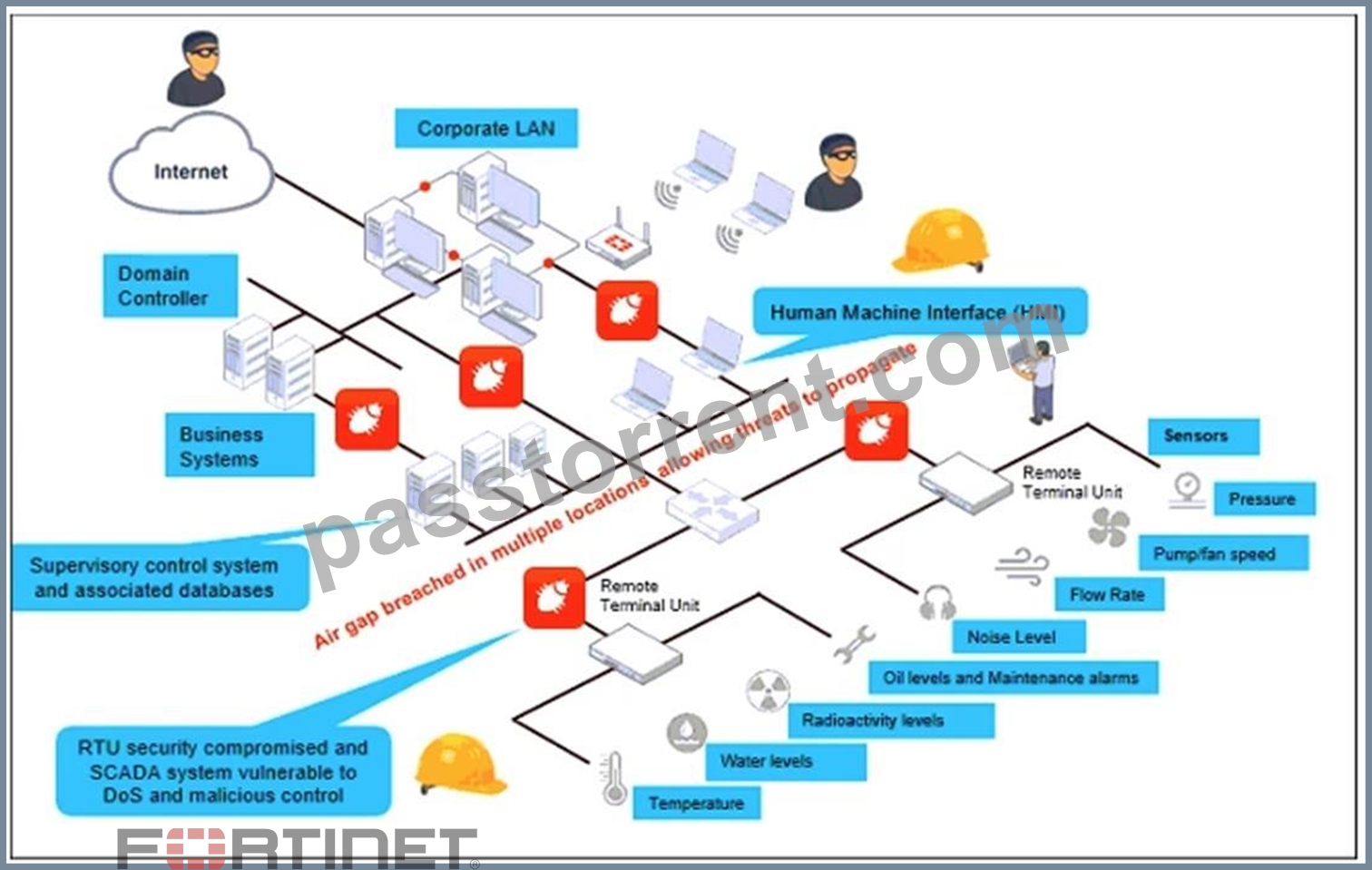
- A. Configure firewall policies with industrial protocol sensors.
- B. Deploy a FortiGate device within each ICS network.
- C. Use segmentation.
- D. Configure firewall policies with web filtering to protect the different ICS networks.
- E. Deploy an edge FortiGate between the internet and the OT network as a one-arm sniffer.
Answer: A,B,C
Explanation:
Use segmentation: Network segmentation is critical in an OT environment to isolate different ICS (Industrial Control System) networks and protect sensitive systems. This limits the spread of threats and provides controlled access between segments.
Deploy a FortiGate device within each ICS network: Deploying FortiGate devices in each ICS network ensures that localized security measures are in place to detect and prevent unauthorized access or threats.
Configure firewall policies with industrial protocol sensors: Configuring policies with industrial protocol sensors helps monitor and protect OT-specific traffic (e.g., Modbus, DNP3).
This enables the FortiGate to detect and respond to malicious activities targeting OT protocols.
NEW QUESTION # 53
Which three criteria can a FortiGate device use to look for a matching firewall policy to process traffic? (Choose three.)
- A. Highest to lowest priority defined in the firewall policy
- B. Source defined as internet services in the firewall policy
- C. Services defined in the firewall policy.
- D. Lowest to highest policy ID number
- E. Destination defined as internet services in the firewall policy
Answer: A,C,E
Explanation:
The three criteria that a FortiGate device can use to look for a matching firewall policy to process traffic are:
A) Services defined in the firewall policy - FortiGate devices can match firewall policies based on the services defined in the policy, such as HTTP, FTP, or DNS.
D) Destination defined as internet services in the firewall policy - FortiGate devices can also match firewall policies based on the destination of the traffic, including destination IP address, interface, or internet services.
E) Highest to lowest priority defined in the firewall policy - FortiGate devices can prioritize firewall policies based on the priority defined in the policy. The device will process traffic against the policy with the highest priority first and move down the list until it finds a matching policy.
NEW QUESTION # 54
Refer to the exhibit. An operational technology rule is created and successfully activated to monitor the Modbus protocol on FortiSIEM. However, the rule does not trigger incidents despite Modbus traffic and application logs being received correctly by FortiSIEM.
Which statement correctly describes the issue on the rule configuration?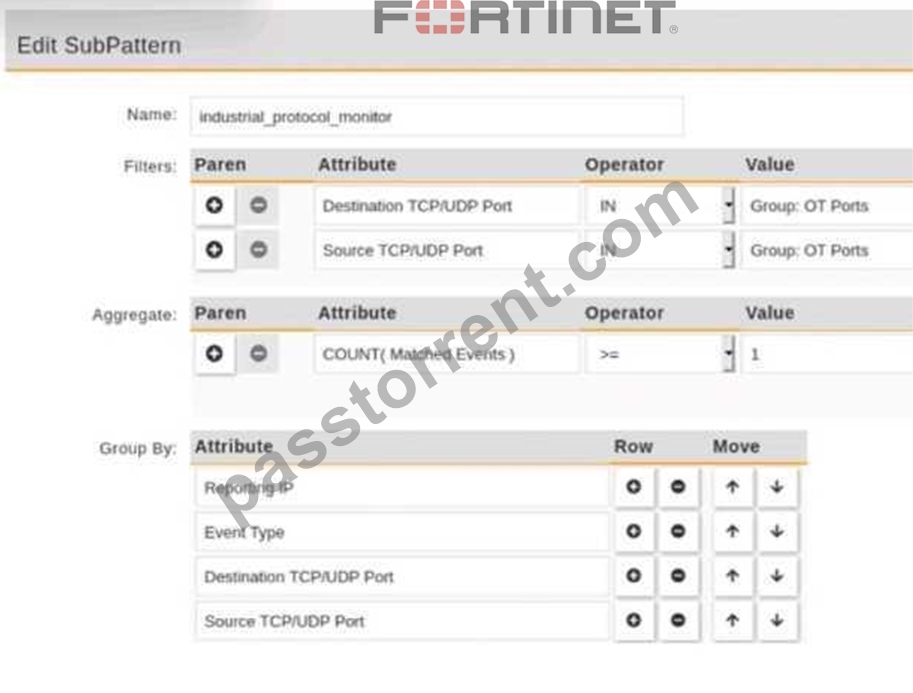
- A. The Aggregate attribute COUNT expression is incompatible with the filters.
- B. The attributes in the Group By section must match the ones in Fitters section.
- C. The first condition on the SubPattern filter must use the OR logical operator.
- D. The SubPattern is missing the filter to match the Modbus protocol.
Answer: B
NEW QUESTION # 55
Which two frameworks are common to secure ICS industrial processes, including SCADA and DCS?
(Choose two.)
- A. NIST Cybersecurity
- B. IEC 62443
- C. Modbus
- D. IEC104
Answer: A,B
Explanation:
* B. NIST Cybersecurity Framework (CSF)
* Role: Provides a risk-based approach to manage cybersecurity for critical infrastructure (including ICS/SCADA/DCS).
* Fortinet Reference:
Fortinet OT Security Solution Guide (v7.2):
"The NIST Cybersecurity Framework is widely adopted in OT environments to align security practices with business objectives, manage risks, and ensure resilience." Page 12: "Framework adoption (e.g., NIST CSF) helps organizations prioritize OT asset protection."
* C. IEC 62443
* Role: International standard specifically designed for ICS/OT security, covering technical controls, processes, and risk management.
* Fortinet Reference:
*Fortinet NSE 7 - OT Security 7.2 Study Guide*:
"IEC 62443 is the foundational standard for securing industrial automation and control systems (IACS), including SCADA and DCS. It defines security zones, conduits, and security levels (SLT)."
*Module 4: "IEC 62443 provides OT-specific security requirements not covered by IT frameworks."* Why Other Options Are Incorrect
* A. Modbus: A communication protocol (not a framework) used in OT environments. It lacks security features and governance.
FortiGate OT Security Guide:
"Modbus is an unauthenticated, cleartext protocol vulnerable to eavesdropping. It is not a security framework."
* D. IEC 104: A telecontrol protocol for SCADA (based on IEC 60870-5-104). It is not a security framework.
FortiSIEM OT Monitoring Handbook:
"IEC 104 is used for data transmission in electrical grids. Like Modbus, it requires external security controls." Key Documentation Extracts
* Fortinet OT Security Solution Guide (v7.2):
*"Industrial environments align with IEC 62443 for OT-specific controls and NIST CSF for risk governance.
Protocols like Modbus/IEC 104 require additional hardening."*
* NSE 7 OT Security 7.2 Curriculum:
"IEC 62443 addresses OT asset discovery, segmentation, and threat detection. NIST CSF complements it with risk assessment methodologies."
NEW QUESTION # 56
......
Most Reliable Fortinet NSE7_OTS-7.2 Training Materials: https://pass4sure.passtorrent.com/NSE7_OTS-7.2-latest-torrent.html