


VALID 350-701 Exam Dumps For Certification Exam Preparation
350-701 Dumps PDF 2024 Strategy Your Preparation Efficiently
Understanding functional and technical aspects of Implementing and Operating Cisco Security Core Technologies (SCOR 350-701) Security Concepts
The following will be discussed in CISCO 350-701 exam dumps:
- Describe security intelligence authoring, sharing, and consumption
- On-premises: viruses, trojans, DoS/DDoS attacks, phishing, rootkits, man-in-themiddle attacks, SQL injection, cross-site scripting, malware
- Explain common threats against on-premises and cloud environments
- Compare common security vulnerabilities such as software bugs, weak and/or hardcoded passwords, SQL injection, missing encryption, buffer overflow, path traversal, cross-site scripting/forgery
- Interpret basic Python scripts used to call Cisco Security appliances APIs
- Compare site-to-site VPN and remote access VPN deployment types such as sVTI, IPsec, Cryptomap, DMVPN, FLEXVPN including high availability considerations, and AnyConnect
- Describe functions of the cryptography components such as hashing, encryption, PKI, SSL, IPsec, NAT-T IPv4 for IPsec, pre-shared key and certificate based authorization
- Cloud: data breaches, insecure APIs, DoS/DDoS, compromised credentials
Cisco 350-701 exam, also known as Implementing and Operating Cisco Security Core Technologies, is a certification exam that assesses the knowledge and skills of IT professionals in implementing and operating core security technologies. 350-701 exam is designed for security professionals who work with Cisco technologies and are responsible for securing enterprise networks.
Exam Details
The Cisco 350-701 test has the allocated duration of 120 minutes. The vendor doesn’t publish the exact number of questions and their formats prior to the exam date. However, according to the experience of the former test takers, the exam contains from 90 to 110 questions. The test is delivered in Japanese and English. The candidates can choose to sit for the exam in person at one of the authorized testing centers or take it via online proctoring. Each student is required to pay the registration fee of $400 to schedule the exam. This applies to a single delivery of the test. In case if one fails the first attempt, he or she will have to wait for 5 calendar days and pay another fee before retaking the exam.
NEW QUESTION # 335
What are two workload security models? (Choose two.)
- A. IaaS
- B. PaaS
- C. off-premises
- D. on-premises
- E. SaaS
Answer: C,D
Explanation:
Workload security models refer to the ways of protecting applications, services, and capabilities that run on a cloud resource. There are different types of cloud deployment models, such as public, private, hybrid, and multicloud, and different types of cloud service models, such as IaaS, PaaS, and SaaS. However, these are not workload security models, but rather ways of describing the cloud environment and the level of abstraction.
Workload security models are more focused on the location and ownership of the workloads, and how they are secured. The two main workload security models are off-premises and on-premises. Off-premises workload security model means that the workloads are hosted and managed by a third-party cloud service provider, such as AWS, Azure, or GCP. The cloud service provider is responsible for the security of the underlying infrastructure, such as the physical servers, network devices, storage systems, and hypervisors. The customer is responsible for the security of the workloads themselves, such as the guest operating systems, applications, data, and users. The customer can use various tools and techniques to secure their workloads, such as encryption, firewalls, identity and access management, vulnerability scanning, and logging and monitoring.
On-premises workload security model means that the workloads are hosted and managed by the customer on their own data center or private cloud. The customer is responsible for the security of both the infrastructure and the workloads, and has full control and visibility over them. The customer can use similar tools and techniques as the off-premises model, but also has to deal with the physical security, network security, and compliance requirements of their own environment. References:
* What Is Workload Security? On-Premises, Cloud, Kubernetes, and More
* What is Cloud Workload Security? - CyberArk
* What is Cloud Workload Protection? | Workload Security | VMware
* What is Cloud Workload Security? - Check Point Software
* Introduction To Classic Security Models - GeeksforGeeks
NEW QUESTION # 336
Refer to the exhibit,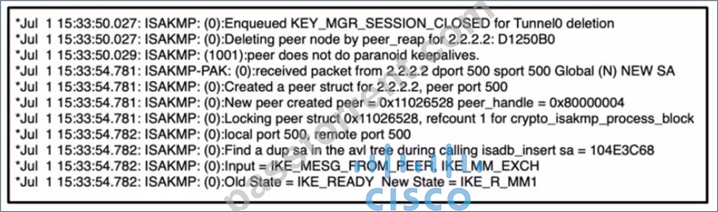
which command results in these messages when attempting to troubleshoot an iPsec VPN connection?
- A. debug crypto isakmp
- B. debug crypto isakmp connection
- C. debug crypto Ipsec
- D. debug crypto ipsec endpoint
Answer: A
NEW QUESTION # 337
Refer to the exhibit.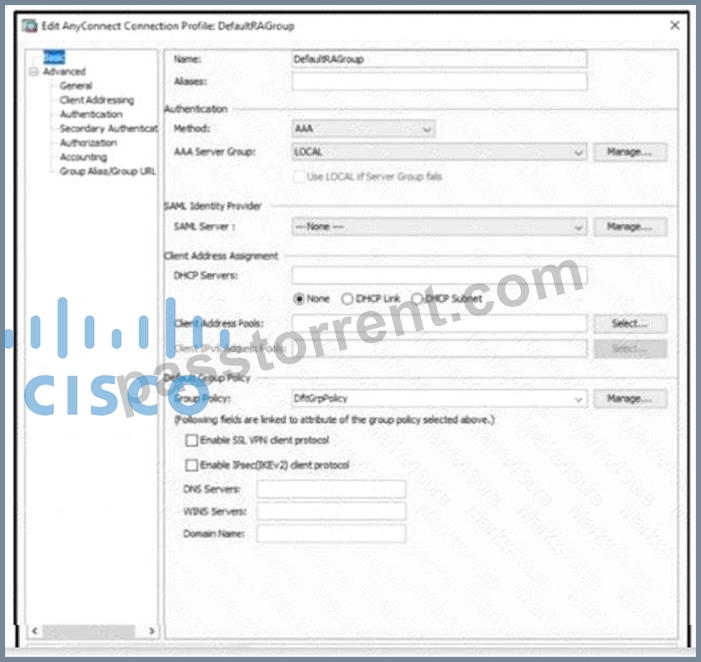
When configuring a remote access VPN solution terminating on the Cisco ASA, an administrator would like to utilize an external token authentication mechanism in conjunction with AAA authentication using machine certificates. Which configuration item must be modified to allow this?
- A. Group Policy
- B. SAML Server
- C. Method
- D. DHCP Servers
Answer: C
Explanation:
Explanation In order to use AAA along with an external token authentication mechanism, set the "Method" as
"Both" inthe Authentication.
NEW QUESTION # 338
Refer to the exhibit.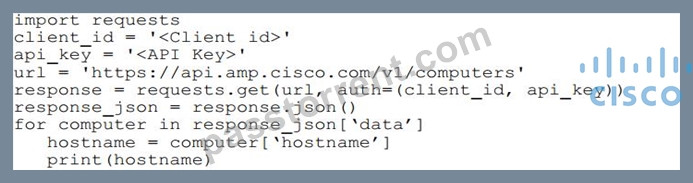
What will happen when the Python script is executed?
- A. The script will translate the IP address to FODN and print it
- B. The hostname will be translated to an IP address and printed.
- C. The hostname will be printed for the client in the client ID field.
- D. The script will pull all computer hostnames and print them.
Answer: D
NEW QUESTION # 339
Which two services must remain as on-premises equipment when a hybrid email solution is deployed? (Choose two)
- A. DDoS
- B. encryption
- C. antivirus
- D. DLP
- E. antispam
Answer: B,D
Explanation:
Cisco Hybrid Email Security is a unique service offering that combines a cloud-based email security deployment with an appliance-based email security deployment (on premises) to provide maximum choice and control for your organization. The cloud-based infrastructure is typically used for inbound email cleansing, while the onpremises appliances provide granular control - protecting sensitive information with data loss prevention (DLP) and encryption technologies.
Reference:
Cisco_Cloud_Hybrid_Email_Security_Overview_Guide.pdf
NEW QUESTION # 340
Drag and drop the steps from the left into the correct order on the right to enable AppDynamics to monitor an EC2 instance in Amazon Web Services.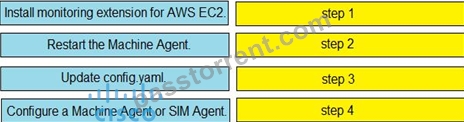
Answer:
Explanation: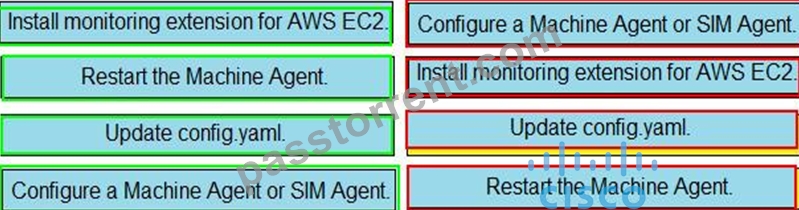
NEW QUESTION # 341
In an IaaS cloud services model, which security function is the provider responsible for managing?
- A. Internet proxy
- B. hypervisor OS hardening
- C. CASB
- D. firewalling virtual machines
Answer: D
Explanation:
ExplanationIn this IaaS model, cloud providers offer resources to users/machines that include computers as virtualmachines, raw (block) storage, firewalls, load balancers, and network devices.Note: Cloud access security broker (CASB) provides visibility and compliance checks, protects data against misuse and exfiltration, and provides threat protections against malware such as ransomware.
NEW QUESTION # 342
Why should organizations migrate to a multifactor authentication strategy?
- A. Single methods of authentication can be compromised more easily than multifactor authentication
- B. Multifactor authentication methods of authentication are never compromised
- C. Biometrics authentication leads to the need for multifactor authentication due to its ability to be hacked easily
- D. Multifactor authentication does not require any piece of evidence for an authentication mechanism
Answer: A
NEW QUESTION # 343
Drag and drop the solutions from the left onto the solution's benefits on the right.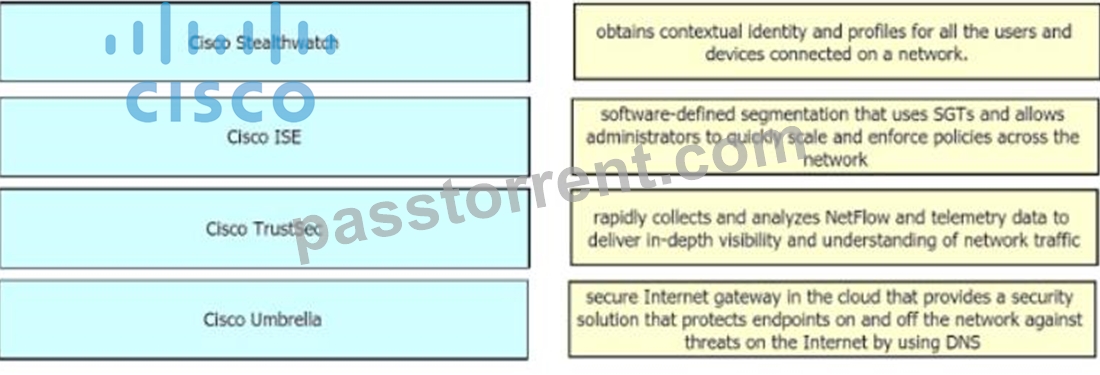
Answer:
Explanation: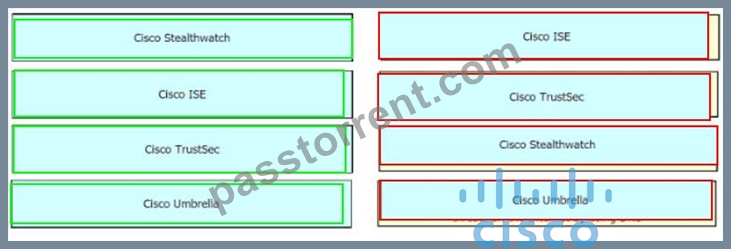
NEW QUESTION # 344
Using Cisco Firepower's Security Intelligence policies, upon which two criteria is Firepower block based? (Choose two.)
- A. port numbers
- B. URLs
- C. MAC addresses
- D. IP addresses
- E. protocol IDs
Answer: B,D
Explanation:
NEW QUESTION # 345
An engineer used a posture check on a Microsoft Windows endpoint and discovered that the MS17-010 patch was not installed, which left the endpoint vulnerable to WannaCry ransomware. Which two solutions mitigate the risk of this ransom ware infection? (Choose two)
- A. Configure a posture policy in Cisco Identity Services Engine to check that an endpoint patch level is met before allowing access on the network.
- B. Configure endpoint firewall policies to stop the exploit traffic from being allowed to run and replicate throughout the network.
- C. Configure a posture policy in Cisco Identity Services Engine to install the MS17-010 patch before allowing access on the network.
- D. Set up a well-defined endpoint patching strategy to ensure that endpoints have critical vulnerabilities patched in a timely fashion.
- E. Set up a profiling policy in Cisco Identity Service Engine to check and endpoint patch level before allowing access on the network.
Answer: A,C
Explanation:
ExplanationA posture policy is a collection of posture requirements, which are associated with one or more identity groups, and operating systems. We can configure ISE to check for the Windows patch at Work Centers > Posture > Posture Elements > Conditions > File.In this example, we are going to use the predefined file check to ensure that our Windows 10 clients have the critical security patch installed to prevent the Wanna Cry malware.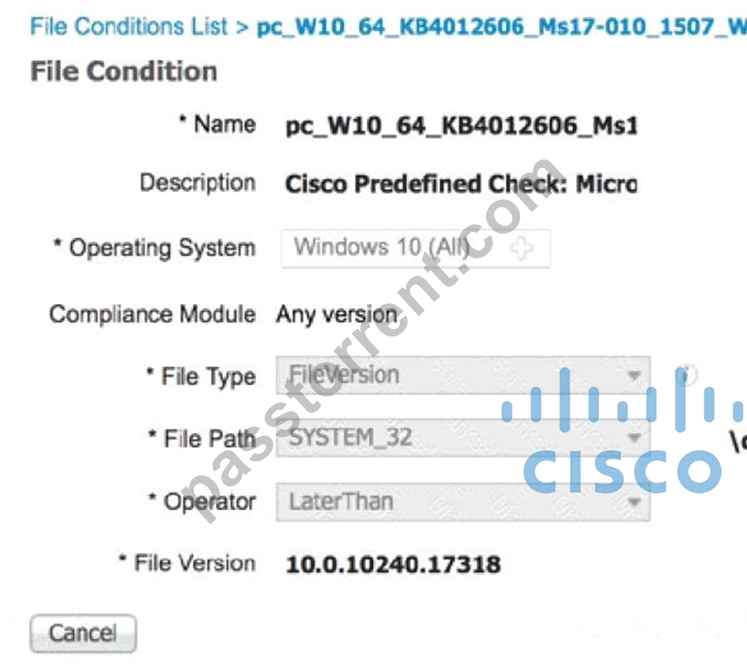
NEW QUESTION # 346
An engineer needs a cloud solution that will monitor traffic, create incidents based on events, and integrate with other cloud solutions via an API. Which solution should be used to accomplish this goal?
- A. CASB
- B. Cisco Cloudlock
- C. SIEM
- D. Adaptive MFA
Answer: B
Explanation:
+ Cisco Cloudlock continuously monitors cloud environments with a cloud Data Loss Prevention (DLP) engine to identify sensitive information stored in cloud environments in violation of policy.
+ Cloudlock is API-based.
+ Incidents are a key resource in the Cisco Cloudlock application. They are triggered by the Cloudlock policy engine when a policy detection criteria result in a match in an object (document, field, folder, post, or file).
Reference:
Note:
+ Security information and event management (SIEM) platforms collect log and event data from security systems, networks and computers, and turn it into actionable security insights.
+ An incident is a record of the triggering of an alerting policy. Cloud Monitoring opens an incident when a condition of an alerting policy has been met.
NEW QUESTION # 347
What is a characteristic of Firepower NGIPS inline deployment mode?
- A. It cannot take actions such as blocking traffic.
- B. ASA with Firepower module cannot be deployed.
- C. It is out-of-band from traffic.
- D. It must have inline interface pairs configured.
Answer: D
Explanation:
Firepower NGIPS inline deployment mode is a mode where the NGIPS device is placed in the traffic path and can take actions such as blocking, modifying, or redirecting traffic based on the policies and rules. In this mode, the NGIPS device must have inline interface pairs configured, which are pairs of physical or logical interfaces that act as a single logical interface. The inline interface pairs are connected to the network devices on both sides of the NGIPS device, and the traffic flows through the NGIPS device from one interface to the other. The NGIPS device can inspect and modify the traffic as it passes through the inline interface pairs12. References := 1: Firepower Management Center Configuration Guide, Version 6.6 - Device Management Basics 2: Configure FTD Interfaces in Inline-Pair Mode
NEW QUESTION # 348
An organization uses Cisco FMC to centrally manage multiple Cisco FTD devices. The default management port conflicts with other communications on the network and must be changed. What must be done to ensure that all devices can communicate together?
- A. Set the tunnel to go through the Cisco FTD
- B. Change the management port on Cisco FMC so that it pushes the change to all managed Cisco FTD devices
- C. Set the tunnel port to 8305
- D. Manually change the management port on Cisco FMC and all managed Cisco FTD devices
Answer: D
Explanation:
The FMC and managed devices communicate using a two-way, SSL-encrypted communication channel, which by default is on port 8305.
Cisco strongly recommends that you keep the default settings for the remote management port, but if the management port conflicts with other communications on your network, you can choose a different port. If you change the management port, you must change it for all devices in your deployment that need to communicate with each other.
NEW QUESTION # 349
How many interfaces per bridge group does an ASA bridge group deployment support?
- A. up to 2
- B. up to 8
- C. up to 4
- D. up to 16
Answer: C
Explanation:
Each of the ASAs interfaces need to be grouped into one or more bridge groups. Each of these groups acts as an independent transparent firewall. It is not possible for one bridge group to communicate with another bridge group without assistance from an external router.
As of 8.4(1) upto 8 bridge groups are supported with 2-4 interface in each group. Prior to this only one bridge group was supported and only 2 interfaces.
Up to 4 interfaces are permitted per bridge-group (inside, outside, DMZ1, DMZ2)
NEW QUESTION # 350
Which open standard creates a framework for sharing threat intelligence in a machine-digestible format?
- A. CybOX
- B. OpenC2
- C. STIX
- D. OpenlOC
Answer: C
NEW QUESTION # 351
Drag and drop the exploits from the left onto the type of security vulnerability on the right.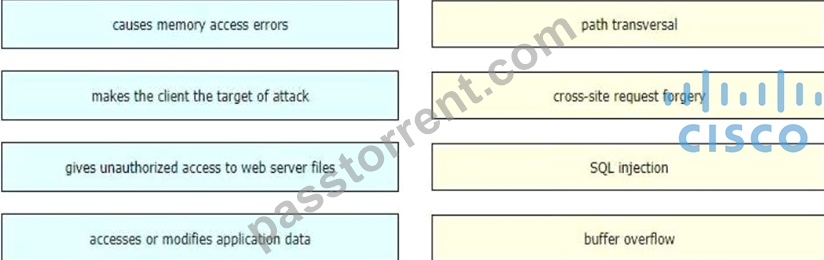
Answer:
Explanation: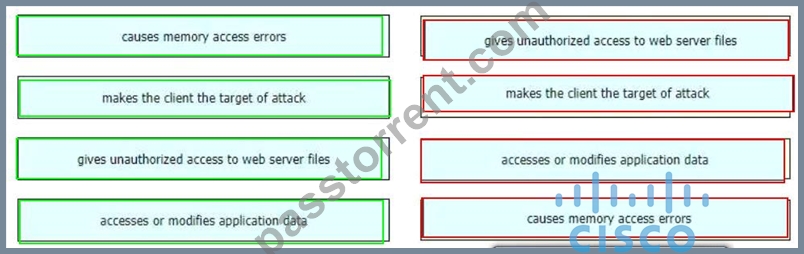
NEW QUESTION # 352
Which CLI command is used to enable URL filtering support for shortened URLs on the Cisco ESA?
- A. outbreakconfig
- B. websecurity config
- C. websecurity advancedconfig
- D. webadvancedconfig
Answer: C
NEW QUESTION # 353
With which components does a southbound API within a software-defined network architecture communicate?
- A. devices such as routers and switches
- B. appliances
- C. applications
- D. controllers within the network
Answer: A
NEW QUESTION # 354
Which two capabilities does TAXII support? (Choose two.)
- A. exchange
- B. correlation
- C. mitigating
- D. pull messaging
- E. binding
Answer: A,D
NEW QUESTION # 355
Which statement about the configuration of Cisco ASA NetFlow v9 Secure Event Logging is true?
- A. A flow-export event type must be defined under a policy.
- B. To view bandwidth usage for NetFlow records, the QoS feature must be enabled.
- C. Asysoptcommand can be used to enable NSEL on a specific interface.
- D. NSEL can be used without a collector configured.
Answer: A
NEW QUESTION # 356
......
Latest Verified & Correct 350-701 Questions: https://pass4sure.passtorrent.com/350-701-latest-torrent.html